We all have things that make us who we are; formative influences and experiences. Sometimes, these are positive things, sometimes negative, but the sum of these, and our reactions to them, help to determine the course of our lives. What is vastly interesting is that three people can experience the same things, and each may go a completely different way in reaction.
I grew up in Eastern Ontario, in a very rural area. There were twelve houses, a graveyard and a corner store with a single gas pump in my community. This was, of course, in the pre-internet days. We had two channels on the tv, but we didn’t watch it very much. Mostly, we spent our time outside. We had forest and marshland, an old foundation grown up with cedar trees for a fort, a marvellous hill for sledding and riding bikes down, and full access to the river through the neighbour’s yard with our canoe, kayak, or the raft we built one summer (hahaha, 2×4’s don’t float! Ask me how I know) It was a wonderful way to grow up. Had I grown up inside a town, or in the internet generation, I would likely be very different from who I am today.
We were all readers, with the exception of one of my brothers. He loved to listen to a story read out loud, but would rather be running wild in the woods than sit quietly and read. It wasn’t remotely uncommon for me to read a couple books in a single day. I loved historically-based stories the most. By the time I was twelve years old, I had worn the covers off my ‘Little House on the Prairie’ box set. The simplicity and common knowledge of that time in history fascinated me.
As I got older, I spent summers working at a historical interpretation center. I lived the mid-nintheeth century life from 830 am to 5pm. And I loved it. I learned things there. My skillset by the time I was in my teens was considerably different from most of my peer group. They spent their summers with television and sports games; I spent mine feeding livestock, milking cows, churning butter, making cheese and bread, learning to weave baskets and spin wool. As a result, I look at the world through a different filter than most my age. I still have one of the baskets, too.
In the winter of 1998, a massive Ice Storm shut down Eastern Ontario and a good swath of Quebec. Hundreds of thousands of people lost power for weeks. The damage was catastrophic. The military was mobilised to help. It was a very big deal. Our area was without power for two weeks. There was six inches of ice on the ground and on the trees. A single pine needle would be as big around as your finger. It was beautiful in a deadly way. Everything sparkled, as if we were living in a glass kingdom. But the ice killed. Trees would snap off abruptly and come hurtling down on anyone unwary enough to be nearby. Power lines were torn down and broken in countless places. So very many people were freezing cold, in the dark, with no way to feed themselves or take care of their most basic hygienic needs.
Our family was fine.
We had a woodstove. And a kerosene lamp. And those simple facts made all the difference. We just moved into the family room, closed off the rest of the rooms to conserve heat, and we did very well indeed. We were warm. We could cook. We constantly had a pot of ice melting on the stove, so we had water to drink, wash, and flush with. We heard many people wailing about hundreds of dollars of food going bad without fridge or freezer, but THERE WAS SIX INCHES OF ICE ON THE GROUND. The whole outside was a freezer. Our food was perfectly fine in boxes on the back deck. We lost a tray of meat to the neighbours’ dog, but that was all. We actually enjoyed those two weeks immensely, because we had those two things.
After that experience, I would never own a house that didn’t have a woodstove. Our last house had two – one in the living room, one in the dining room. I also always had kerosene lamps. Battery lanterns and flashlights are fine…until your batteries run out and the stores dont have power either so you can’t get more. We lost power at least three times every winter at the last place. Old house. Rural area. We were always fine. We had heat. We could cook. We could always melt snow for water. But then we lost power one summer. Only for a couple days, but it showed us that we still had one glaring vulnerability. The well pump was electric. And there is no handy-dandy snow in summer. We had only the water I had stored away – only about 50 gallons -for an unknown amount of time. Not a fun situation.
This time around, we went into it planning ahead for just these issues. Self-sufficiency means that, among other things, when unexpected disasters happen, you’re not dependant on others to rescue you or to provide the basic necessities. We planned for extended power-down situations. Our society is increasingly dependant on technology and electrical appliances to the point that without those things, people are unable to function on the most basic levels. We set out to challenge that. Electricity (and its conveniences) is a very new thing in terms of world history. People lived, and lived quite well, for thousands and thousands of years without it. We can, too.
“But why the heck would you want to do that? It’s so much work!”
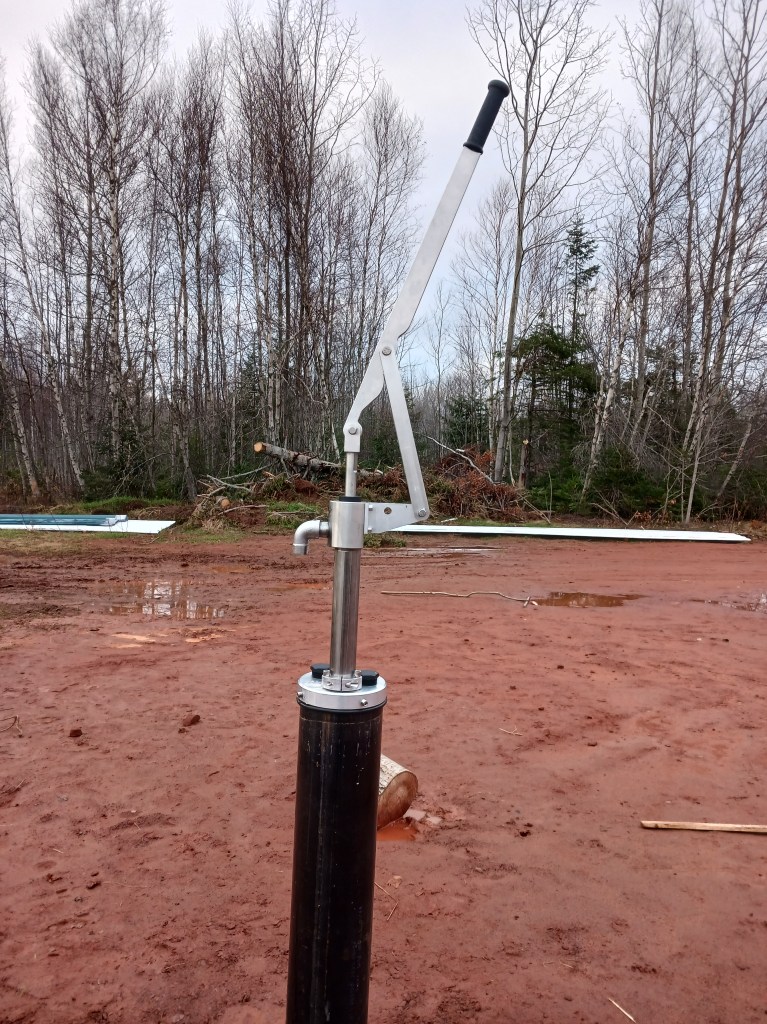
I’ve heard a hundred variations of that refrain, ever since we first began dreaming and planning and discussing this move. People simply cannot wrap their minds around why someone would choose to have laundry tubs and a scrub board. A washing machine is so much easier!…when it is working. Why would we CHOOSE to pump water by hand? There are electric pumps for that…when there is power. Why on EARTH would we choose to deal with the work and the mess of a wood-fired cookstove? Propane or electric is cheaper and tidier….until the power goes out for weeks and you can’t buy more propane because the stores that sell it have no power, either.
This part of the country had a hurricane a few months ago. Power was out for six to twenty days, depending on where you lived.
I haven’t heard that question much since then. But someone did ask me where we got our water pump.
 Off The Beaten Path